

A carefully layered routine can support skin comfort, but it can’t switch off the hormones behind recurring chin breakouts. If you’re searching for how to treat hormonal acne on chin with k-beauty, that distinction matters: the right products may help support clearer, calmer-looking skin, but skincare has limits.
Spots that keep returning around the chin and jawline can be frustrating, especially when strong cleansers and too many active ingredients leave your skin feeling tight or irritated. You don’t need a complicated shelf to get started. A gentle, consistent routine is a more practical first step.
In this UK guide, you’ll find simple morning and evening steps, plus a closer look at K-Beauty ingredients that may suit breakout-prone skin, from calming formulas to gentle exfoliants. We’ll cover what skincare can realistically do, what it can’t, and when persistent, painful or scarring acne is a reason to speak to your GP or pharmacist. Build a routine that feels supportive, not stripping, and know when it’s time to look beyond skincare.
Key Takeaways
- Chin and jawline breakouts can follow a recurring pattern, but their location alone can’t confirm a hormonal cause.
- Learn how to treat hormonal acne on chin with k-beauty by keeping your routine simple: gentle cleansing, moisturiser and daytime sun protection.
- Explore which skincare ingredients may support breakout-prone skin, and how their role differs from acne medicines.
- Start with a steady baseline routine, introduce new products gradually and stop if irritation develops.
- Find out when persistent, painful, scarring or distressing acne calls for advice from a GP or pharmacist.
What hormonal acne on the chin can look like, and what skincare can do
Breakouts around the chin can seem to follow a pattern, especially when spots return in the same area. But their location alone can’t tell you why they’re happening. Hormonal-pattern acne describes how breakouts may behave; it isn’t a diagnosis based on where they appear.
In brief: hormonal-pattern acne describes recurring breakouts that may be influenced by hormone changes; chin spots alone can’t confirm a hormonal cause. Acne vulgaris can involve hormones as part of its development, but other factors may also play a role. The Acne vulgaris overview offers useful background on acne and its possible contributors.
Why breakouts may keep returning around the chin
Hormones can influence how much oil the skin produces. Changes linked with the menstrual cycle may coincide with flare-ups for some people, while medicines or other health factors may also contribute. A recurring pattern, inflamed spots or tenderness can be clues to discuss with a healthcare professional, but none confirms the cause on its own.
Acne can affect adults of any gender. If breakouts persist, a GP or pharmacist can help assess your individual situation rather than relying on chin location or appearance alone.
What a K-Beauty routine can, and cannot, promise
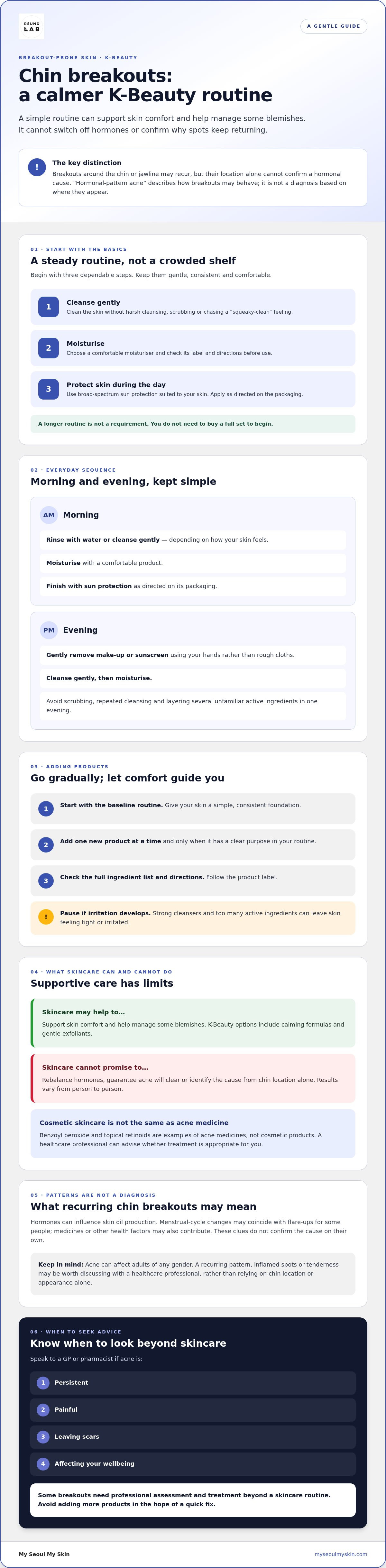
Keep the foundations calm and consistent: cleanse gently, moisturise and use daytime sun protection. A thoughtfully chosen K-Beauty routine can support skin comfort and help manage some blemishes, but cosmetic skincare can’t rebalance hormones or guarantee that acne will clear. More steps aren’t automatically better, particularly if your skin becomes irritated.
Results vary from person to person. If you’re wondering how to treat hormonal acne on chin with k-beauty, think of skincare as supportive care, not a substitute for acne treatment when that’s needed. Acne medicines such as benzoyl peroxide or topical retinoids are different from cosmetic products. A healthcare professional can advise whether treatment is appropriate for you.
Notice what your skin is telling you. If acne is persistent, painful, leaving scars or affecting your wellbeing, don’t keep adding products in the hope of a quick fix. Seek advice from a GP or pharmacist. Some breakouts need professional assessment and treatment beyond a skincare routine.
How to treat hormonal acne on chin with K-Beauty: a gentle routine
Start with three dependable steps: gentle cleansing, moisturising and daytime sun protection. This gives your skin a simple foundation without turning your bathroom shelf into a ten-step project. The best routine is one you can follow consistently and comfortably. K-Beauty offers plenty of choice, but a longer routine isn’t a requirement for clearer-looking skin.
If you’re exploring what hormonal acne is, remember that a skincare routine supports the skin’s surface; it doesn’t address hormone levels. Keep your starting routine uncomplicated, then add a product only if you have a clear reason to try it.
A simple morning routine for breakout-prone skin
In the morning, rinse with water or use a gentle cleanser, depending on how your skin feels. Follow with a comfortable moisturiser, checking its label and directions before use. Finish with broad-spectrum sun protection suited to your skin. Apply it as directed on the packaging, and make it your final skincare step before make-up.
An uncomplicated evening routine
At night, gently remove make-up or sunscreen. Use your hands rather than rough cloths, and avoid scrubbing or repeatedly cleansing to chase a squeaky-clean feeling. Follow with a gentle cleanser and moisturiser. If you’re new to skincare, don’t layer several unfamiliar active ingredients in one evening. The goal is a clean, comfortable finish, not a complicated ritual.
Want more guidance on putting steps in order? Explore the published Korean skincare routine guide for broader routine-building tips. Keep your own version tailored to how your skin feels, rather than adding every step you see online.
Your simple routine: In the morning, rinse or cleanse, moisturise and apply sun protection. In the evening, gently remove make-up or sunscreen, cleanse and moisturise. Introduce one new product at a time, follow its label directions and pause if irritation develops. You don’t need to buy a full set to begin.
Once this baseline feels comfortable, consider whether a targeted product has a clear purpose in your routine. Check its full ingredient list and instructions before choosing. If you’re browsing Korean skincare, explore the curated skincare selection and assess each item individually rather than assuming every product suits breakout-prone skin.
Which skincare ingredients are worth considering for chin breakouts?
Ingredient lists can help you choose products with a clear purpose, but no cosmetic ingredient can promise to stop hormonal-pattern acne. Think of skincare as support for comfort and routine consistency, not a way to correct hormone levels. If you’re researching how to treat hormonal acne on chin with k-beauty, distinguish soothing or hydrating skincare from medicines intended to treat acne.
Soothing and barrier-supporting ingredients in K-Beauty
Centella asiatica, often called cica, is used in some skincare for its soothing properties. It may appeal if your skin feels easily unsettled, but it isn’t an acne cure. A comfortable moisturiser can help keep your routine manageable, especially if your skin feels dry or tight. Choose based on the product’s full ingredient list and directions, not a single headline ingredient.
Formulas vary, even within the same brand. Before choosing a product, check its current label for the ingredients you’re looking for and anything you know your skin doesn’t tolerate. Don’t assume a particular active or formula is stocked; product ranges and ingredient lists can change.
How to approach exfoliating or acne-focused actives
Salicylic acid is an exfoliating ingredient that may suit some breakout-prone routines, but it can cause dryness or irritation, particularly if used too often or alongside other strong products. Start cautiously, follow the product directions and avoid introducing several exfoliants or unfamiliar actives at once. If your skin stings, becomes very dry or looks increasingly irritated, stop using the new product.
Skincare support can soothe and moisturise; acne medicines are designed to treat acne. Benzoyl peroxide and topical retinoids are medicines, not interchangeable with cosmetic ingredients such as cica or exfoliating skincare. A pharmacist or GP can advise on treatment options and suitability, including if you’re pregnant, planning a pregnancy or breastfeeding. Don’t start a medicine or assume an active is appropriate for you based on an online routine alone.
Keep your choices focused: look for a product that addresses one need, check its complete ingredient list and follow its label. If you’re unsure whether a product is cosmetic skincare or a medicine, or whether an ingredient is suitable for you, ask a pharmacist or GP before using it. Persistent or painful acne may need a treatment plan beyond skincare.
How to introduce K-Beauty products without aggravating chin acne
Give your skin a steady starting point before adding products aimed at blemishes. Keep your gentle cleanser, moisturiser and daytime sun protection familiar, then introduce just one new product. If you change several steps together, it’s harder to work out what’s helping or causing irritation.
A measured product trial, one change at a time
Check the product label and follow its directions, including any patch-testing instructions. Use the stated amount and don’t apply it to broken or irritated skin. Keep the rest of your routine unchanged while you see how your skin responds. Avoid adding another new product at the same time, even if it seems like a useful companion step.
A simple note on your phone can help: record the product, when you used it and any changes you notice, such as stinging, redness or dryness. This isn’t a way to diagnose acne or identify its cause. It simply gives you a clearer account to refer to if you decide to stop or ask a pharmacist or GP for advice.
Signs your routine may be too irritating
Persistent stinging, marked redness, dryness or peeling are reasons to pause the new product. Return to familiar basics and avoid layering other potentially irritating products over uncomfortable skin. If symptoms continue, worsen or concern you, seek advice from a pharmacist or GP. For more background before choosing products, read the published guide to skincare ingredients to avoid with acne.
Use this checklist to decide what to do next:
- Continue cautiously: Your skin feels comfortable and you’re following the label directions. Keep other routine steps steady.
- Pause: You notice persistent stinging, marked redness, unusual dryness or peeling. Stop the new product and simplify your routine.
- Seek advice: Irritation doesn’t settle, symptoms worsen, or you’re unsure whether the product is suitable. Ask a pharmacist or GP.
Don’t judge a product’s effect on breakouts after only a few uses. Skin can vary from day to day, and new blemishes don’t automatically mean a product is responsible. Track what you notice over time, without increasing use beyond the label directions or pushing through irritation.
A thoughtful approach to how to treat hormonal acne on chin with k-beauty means choosing products carefully, not collecting more steps. Check the full, current ingredient list before buying, as formulas can vary. Browse Korean skincare options and select any new addition with your skin’s comfort in mind.
When K-Beauty is not enough, and what to do next
A skincare routine can support skin comfort, but it isn’t the answer for every breakout. Arrange professional advice if acne is persistent, deep or painful, leaving scars, or affecting your mood and confidence. You don’t need to wait until it feels severe to ask for help.
When to speak to a GP or pharmacist
Speak to a pharmacist or GP if over-the-counter care isn’t helping, spots are extensive or painful, or you’re concerned about scarring. Contact your GP if acne is affecting your mental health. If breakouts begin after starting a medicine, or appear alongside other symptoms that concern you, seek advice rather than trying to diagnose the cause yourself. Don’t stop a prescribed medicine without discussing it with the prescriber.
A pharmacist can discuss suitable options and help you understand when a GP appointment is the better next step. Your GP can assess your individual needs and discuss treatment options in line with current NHS advice and NICE guidance. Depending on the assessment, pharmacy or prescribed treatments may be considered. Some acne needs more than cosmetic skincare, and getting advice is a practical next step, not a sign that your routine has failed.
Choose supportive K-Beauty products with confidence
Keep your skincare edit small. A gentle cleanser, moisturiser and daytime sun protection can support comfort alongside any treatment recommended by a healthcare professional. If you’re working out how to treat hormonal acne on chin with k-beauty, use cosmetics as supportive care, not a replacement for medical advice or treatment.
Before choosing a product, check its current ingredient list and directions, and consider whether it suits your skin and any treatments you’re using. Don’t assume a particular ingredient is present just because it’s associated with a brand or product type. My Seoul My Skin is a UK online retailer offering authentic Korean skincare sourced directly from Seoul, but product suitability is personal and the retailer doesn’t provide medical advice.
- Book an assessment: Acne is persistent, painful, scarring or affecting your wellbeing.
- Ask about a medicine: Breakouts followed a new medicine, or you’re unsure what treatment is suitable.
- Keep skincare supportive: Choose a few comfortable products, check the labels and follow professional guidance.
For a considered routine, explore authentic Korean skincare and check each product’s current ingredients and directions before adding it to your routine.
Build a routine that feels right for your skin
Recurring chin breakouts can be frustrating, but your routine doesn’t need to be complicated. A gentle cleanse, moisturiser and daytime sun protection create a practical foundation. Add new products gradually, check ingredient lists and directions, and pause if your skin becomes irritated.
If you’re considering how to treat hormonal acne on chin with k-beauty, keep expectations realistic: skincare can support skin comfort and help manage some blemishes, but it can’t rebalance hormones. Persistent, painful or scarring acne, or breakouts affecting your wellbeing, deserve advice from a GP or pharmacist. You don’t have to work it out alone.
Choose with care and keep your routine personal. My Seoul My Skin offers authentic Korean skincare sourced directly from Seoul, with a curated range including Numbuzin, VT Cosmetics, Abib and Jumiso. Check current product details and ingredients to find options that suit your needs.
Explore authentic Korean skincare and take your next step with confidence. Small, considered choices can make your routine feel more manageable.
Frequently Asked Questions
Can K-Beauty treat hormonal acne on the chin?
K-Beauty can support skin comfort and help manage some blemishes, but cosmetic products can’t rebalance hormones or guarantee that acne will clear. A gentle cleanser, moisturiser and daytime sun protection can form a simple routine. If you’re researching how to treat hormonal acne on chin with k-beauty, treat skincare as supportive care. Persistent, painful or scarring breakouts may need assessment and treatment from a healthcare professional.
What is the best K-Beauty routine for hormonal chin acne?
Start with a gentle cleanse, a comfortable moisturiser and daytime sun protection. In the evening, gently remove make-up or sunscreen, cleanse and moisturise. You don’t need a long multi-step routine or a matching product set. Check labels and directions, introduce new products one at a time, and pause if irritation develops. A pharmacist or GP can advise if you’re also using acne medicines or need further treatment.
Can salicylic acid help with chin acne, and how should I use it?
Salicylic acid may suit some breakout-prone routines, but it can also cause dryness or irritation, especially if overused or combined with other strong actives. Check the product label and follow its directions; introduce it cautiously and avoid starting several exfoliating products together. Stop if your skin becomes persistently uncomfortable or irritated. Ask a pharmacist or GP for advice if you’re unsure whether it’s suitable alongside other treatments.
Should I stop using skincare if my chin acne gets worse?
Not necessarily, but pause any new product if you develop persistent stinging, marked redness, dryness or peeling. Simplify your routine to familiar, comfortable steps and check the product directions. A new breakout alone doesn’t prove that a product caused it, so note what you’ve used and when. If symptoms persist, worsen or concern you, speak to a pharmacist or GP rather than continuing through irritation.
How do I know whether chin acne is hormonal?
You can’t confirm a hormonal cause from chin location alone. Breakouts that recur, or seem to coincide with menstrual-cycle changes, may suggest a pattern worth discussing, but these clues aren’t a diagnosis. Hormones can influence oil production, and medicines or other health factors may also be involved. A GP can assess your individual symptoms and history. Acne can affect adults of any gender.
When should I see a GP about hormonal acne in the UK?
Contact your GP if acne is persistent, extensive or painful, is leaving scars, or is affecting your mental health. Seek advice if it begins after starting a medicine or appears alongside other symptoms that concern you. A pharmacist can also discuss suitable options and whether you should see a GP. NHS advice and NICE guidance describe UK treatment pathways, which may include medicines after professional assessment.
Can I use Korean skincare alongside acne medication?
Often, skincare can support comfort alongside acne treatment, but suitability depends on the medicine and your skin. Check with your prescriber or pharmacist before adding exfoliants or other active products, and follow the medicine and skincare directions. A gentle cleanser and moisturiser may help keep your routine simple, but don’t stop or change prescribed treatment without professional advice. Ask specifically if you’re pregnant, planning a pregnancy or breastfeeding.