

A QR code, batch number or convincing-looking box may still not be enough to confirm a product is genuine. If you’re wondering how to tell if Korean skincare is fake, look beyond the packaging. Design updates, different print runs and unfamiliar codes can make a genuine product seem uncertain, while an unusually low price or unclear online listing may prompt questions.
Use several clues together rather than relying on one quick test. This checklist shows you how to assess the product and seller, understand what packaging, batch codes, barcodes and QR codes can and can’t prove, and check relevant UK label information. No single visual detail settles every doubt, so consider the wider picture, including sourcing and seller transparency.
Already bought something you’re unsure about? Keep useful evidence and raise your concern calmly. Work through the checks, weigh the signs together, then decide whether to contact the seller or report your concern. The aim is to make your next K-beauty purchase with more confidence, not guesswork.
Key Takeaways
- Learn how to tell if Korean skincare is fake by weighing product and seller clues together instead of relying on packaging alone.
- Follow the checklist from the online listing and seller details to the packaging, product information and brand-specific checks.
- Compare the seller’s identity, sourcing information, contact details, independent reviews and returns information before you buy.
- Photograph the listing and unopened parcel, then keep your order details and any verification results if something seems wrong.
- Find out how to raise a concern calmly and what information to gather before contacting the seller or reporting your suspicions.
How to Tell if Korean Skincare Is Fake: Start with the Limits of Visual Checks
A counterfeit is an unauthorised imitation sold as though it were the genuine product. That’s different from a legitimate packaging redesign, a regional edition or a product with an added translation label. Korean skincare brands may update designs or prepare packaging for different markets, so a mismatch with an image you find online isn’t proof of a fake.
Popular products can attract counterfeit listings, but an unfamiliar seller isn’t automatically dishonest. Treat unusually low prices, vague sourcing and packaging differences as reasons to investigate, not as a verdict. Counterfeit goods can raise safety concerns, as outlined in this overview of the dangers of counterfeit products. Still, don’t assume a product is counterfeit because of one detail alone.
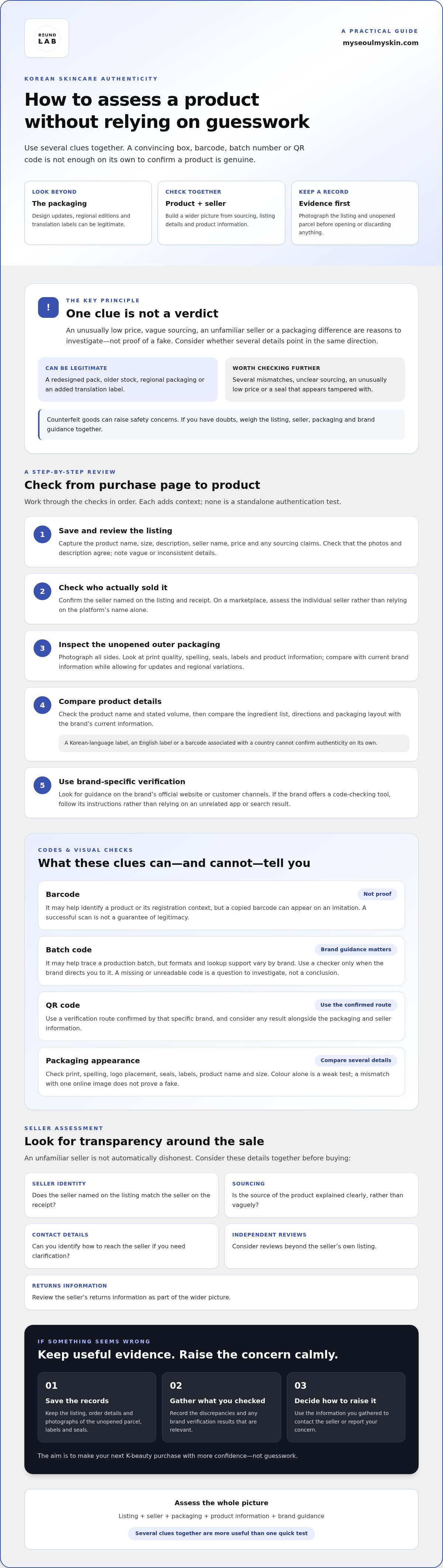
No single visual clue can authenticate every Korean skincare product. To work out how to tell if Korean skincare is fake, look for a pattern across the listing, seller, packaging and brand guidance. One small difference may have a straightforward explanation; several inconsistencies deserve closer attention.
Which packaging differences deserve a closer look?
Compare the product with current information from the brand. Check print quality, spelling, logo placement, seals, labels and details such as the product name and size. Use more than one reference where possible, since older stock and regional packaging may differ from the brand’s latest photographs.
Colour alone is a weak test. Look for several discrepancies together, such as unclear printing alongside misspellings or product details that don’t match the brand’s information. A translation label or revised design may be legitimate. A seal that appears tampered with is a reason to ask the seller or brand for clarification, not instant proof of a fake.
Can a barcode or batch code prove a product is genuine?
No. A barcode can help identify a product or its registration context, but it doesn’t confirm that the item carrying it is authentic. An imitation can use a copied barcode, so scanning a code successfully isn’t a guarantee of legitimacy.
A batch code may help trace a production batch, but formats and lookup support vary by brand. Don’t rely on a generic online checker unless the brand directs you to it. Follow the brand’s own verification guidance where available, and consider any result alongside the packaging and seller information. If a code is missing or unreadable, treat that as one question to investigate, not a conclusion.
A Step-by-Step Korean Skincare Authenticity Checklist for the Product
Work through these checks in order, starting with the purchase page and moving to the product itself. Each step adds context, but none is a standalone test. Before opening or discarding anything, photograph the listing and unopened package, including labels and seals. Those records can help if you need to ask the seller or brand about a discrepancy.
- 1. Save and review the listing. Capture the product name, size, description, seller name, price and any claims about sourcing. Check that the photos and description agree, and note details that seem inconsistent or unusually vague.
- 2. Check who sold it. Confirm the seller named on the listing and receipt. On a marketplace, check the individual seller rather than relying on the platform’s name alone. For broader consumer advice, see advice from The Independent.
- 3. Inspect the unopened outer packaging. Photograph all sides, then check the print, spelling, seals, labels and product information. Compare these details with current information from the brand, allowing for packaging updates or regional variations.
- 4. Compare the product details. Check the product name and stated volume, then compare the ingredient list, directions and packaging layout with the brand’s current information. Consider the details as a whole. A Korean-language label, an English label or a barcode associated with a particular country can’t confirm authenticity on its own.
- 5. Use brand-specific verification. Look for guidance on the brand’s official website or customer channels. If the brand offers a code-checking tool, follow its instructions instead of relying on an unrelated app or search result.
How should you check batch codes, QR codes and verification pages?
Find the batch or QR code on the packaging and use only a verification route confirmed by that specific brand. Before scanning or entering details, check that the destination address belongs to the brand or a verification service it identifies. A failed lookup is a reason to ask the brand, not automatic proof that the product is fake. Missing or unrecognised codes are inconclusive until the brand or seller responds.
What product details should you compare with official brand information?
Compare spelling, volume, ingredients, directions and layout together, using the brand’s current product information where available. Check whether the brand documents a redesign or packaging for a different market. Don’t assume a language difference or country barcode settles the question. If details still don’t line up, keep your photographs and ask the brand or seller to clarify before using the product.
Prefer a retailer that explains its sourcing? My Seoul My Skin offers Korean skincare sourced directly from Seoul. You can browse Korean skincare sourced from Seoul and review the retailer’s information as part of your checks.
How to Assess a Korean Skincare Seller in the UK
A product check tells only part of the story. Look at the retailer’s identity, sourcing and customer information too. No single seller detail confirms that a product is genuine, but a clear and consistent picture can help you decide whether to buy or ask questions first.
| What to check | Look for | Pause if |
|---|---|---|
| Seller identity | A clearly named business and consistent details across its site and checkout. | You can’t tell who is actually selling the product. |
| Sourcing details | A specific explanation of where products come from or how they’re sourced. | Claims are vague, contradictory or absent. |
| Contact information | Accessible customer-service details and a clear way to raise a query. | Contact information is missing or hard to verify. |
| Reviews | Recent feedback across independent review platforms, with recurring patterns you can assess. | Only a handful of ratings are available, or repeated concerns go unanswered. |
| Returns information | Understandable terms explaining how to contact the seller and what to expect if there’s a problem. | The policy is difficult to find or unclear. |
What makes an online skincare seller easier to trust?
Check whether the business explains who it is, how to contact it and where its products come from. Compare those details with the listing: the product name, description and images should tell a consistent story. If possible, read recent reviews on more than one independent platform. Repeated comments about missing parcels or unhelpful responses are more useful to consider than one isolated rating, whether positive or negative.
How should you compare marketplaces and specialist retailers?
On a marketplace, check the individual seller’s identity, history and feedback, not just the platform or listing. For a specialist retailer, look for clear product information and sourcing details. Compare delivery, returns and customer-service information before ordering. These checks help you assess the overall buying experience, but they can’t authenticate an individual item by themselves.
Compare the same product across reputable sellers, checking that the size and version match. Promotions, stock clearance or different delivery arrangements can explain a lower price, so don’t treat a discount as proof of a fake. If an offer seems unusually low, check the seller’s sourcing claims, reviews and terms before buying. That wider picture is more useful than price alone when considering how to tell if Korean skincare is fake.
What to Do if You Suspect Your Korean Skincare Is Fake
Stay calm and keep the product, packaging and purchase records together. If you’re concerned about what’s in the product or how it looks or smells, stop using it while you seek advice. Don’t throw it away or send it back before documenting the details. A missing batch-code result or unusual label doesn’t prove a product is counterfeit, but it’s reasonable to ask questions.
What evidence should you collect before contacting the seller?
Take clear photographs in good lighting before opening or discarding anything. Capture every side of the box and container, the seals, labels, batch or QR codes, and the product itself if it’s already open. Keep the order confirmation and note the seller’s name, purchase date, order reference and listing description. Save screenshots of the listing and any code-check results. Keep messages and replies together so the details are easy to review.
When should you contact the brand or seek UK consumer guidance?
Contact the brand through a channel listed on its official website. Share the product name, batch details and photographs, and identify the specific point you’d like checked, such as whether the packaging matches current information. A code that doesn’t return a result may need brand-specific interpretation. Ask the seller for an explanation too, especially if product details or sourcing remain unclear.
Keep your message factual and concise. For example: “The packaging and product details don’t appear to match the brand’s current information. Could you confirm the product’s source and advise whether these details are expected?” Avoid making public accusations before you’ve gathered a response.
If you remain concerned, check current UK consumer guidance before deciding how to escalate. Citizens Advice can direct consumers to their local Trading Standards service; suspected fraud can also be reported to Action Fraud. Trading Standards may take action against a seller, but it can’t arrange a refund for you. Check the relevant guidance for your situation and contact the seller or payment provider about available options.
Wondering how to tell if Korean skincare is fake after purchase? Keep your evidence, ask the brand and seller, then use current guidance to decide what to do next. If you’re choosing another product, My Seoul My Skin offers Korean skincare sourced directly from Seoul. Explore Korean skincare sourced from Seoul and review the retailer’s sourcing information as part of your checks.
Choose Korean Skincare with Confidence: Check Sourcing Before You Buy
Base your decision on several checks: can you identify the seller, understand its sourcing claims, match the product details with current brand information and find brand-specific verification guidance? Together, these steps can help you shop with more confidence. They don’t turn one reassuring claim or code into proof that an individual product is genuine.
What sourcing questions can you ask a Korean skincare retailer?
Ask how the retailer sources its products and whether it can explain the supply route. Check that the product page names the brand and gives clear, consistent details, such as the product name and size. If the sourcing answer is broad or unclear, ask for clarification and compare it with information from the brand. A transparent response is useful context, not a replacement for product-level checks if something still seems off.
My Seoul My Skin is a UK retailer offering Korean skincare sourced directly from Seoul. Consider that sourcing information alongside the retailer’s product pages and your own checks. It isn’t a reason to ignore packaging differences, an unfamiliar code or another concern.
How can you keep the checklist useful across different K-beauty brands?
Don’t assume every brand uses the same packaging, batch-code format or verification tool. Follow the specific brand’s guidance, and check current product information before ordering because ranges and packaging can change. For example, shoppers comparing Numbuzin or VT Cosmetics can use the relevant UK buying guide for broader brand context, then check the details of the particular product they’re considering. A brand overview can help you browse; it can’t confirm an individual item’s authenticity.
When deciding how to tell if Korean skincare is fake, keep the checks in proportion. Look for a clear seller identity, transparent sourcing, consistent product details and brand-specific guidance. If one detail doesn’t match, ask questions rather than treating it as a final verdict. If several points remain unclear, pause before buying and request more information.
Ready to explore? Browse the listed brands and review the available product information before choosing. Explore Korean skincare sourced directly from Seoul.
Shop Korean Skincare with More Confidence
Knowing how to tell if Korean skincare is fake starts with looking at the whole picture. Packaging differences, codes and low prices can prompt questions, but none proves a product is counterfeit on its own. Check the seller’s identity and sourcing, compare product details with current brand information, and follow that brand’s verification guidance.
If something feels uncertain, pause before using the product. Keep the packaging and purchase records, take clear photographs, then ask the seller or brand for an explanation. A calm, well-documented enquiry can help you decide what to do next without jumping to conclusions.
For your next browse, My Seoul My Skin offers Korean skincare sourced directly from Seoul. The shop lists brands including Numbuzin, VT Cosmetics, Abib and Jumiso. Review the available product information and sourcing details as part of your own checks, then explore Korean skincare sourced directly from Seoul.
Trust your curiosity, take each check step by step, and enjoy discovering K-beauty with greater confidence.
Frequently Asked Questions
Can you tell if Korean skincare is fake from the packaging alone?
No. Packaging can raise questions, but it can’t confirm authenticity by itself. Brands may change designs, make regional versions or add translation labels, so an unfamiliar colour or layout isn’t proof. Compare several details with current brand information, including spelling, seals, product name and stated size. If multiple points don’t match, ask the seller or brand to clarify before using the product.
Does a Korean skincare barcode starting with 880 prove it is genuine?
No. A barcode beginning with 880 doesn’t prove a product is genuine or, on its own, confirm where it was made. Barcodes help identify products or registration contexts, and counterfeit packaging can copy a real code. Treat the number as one detail to compare, not an authenticity test. Check the seller, product information and any verification guidance published by the specific brand.
Can I verify Korean skincare with a batch code?
Sometimes, but batch-code lookup support and formats vary by brand. Use a checking tool only if the brand itself identifies or recommends it, and follow its instructions. A code that returns a result is one clue, not conclusive proof, as codes may be copied. If a code is missing or unrecognised, ask the brand to check it before deciding what it means.
Is unusually cheap Korean skincare always fake?
No. Promotions, clearance stock or differences in delivery arrangements can affect prices, so a low price alone doesn’t prove a product is counterfeit. Compare the same product and size across reputable UK sellers, then look at the seller’s identity, sourcing details, reviews and returns information. If the price seems unusually low and other details are unclear or inconsistent, pause and ask questions before buying.
What should I do if I think my Korean skincare is counterfeit?
Stop using the product if you’re concerned, and keep it and its packaging. Photograph the box, container, seals and codes; save the listing, order confirmation and seller details. Contact the seller and brand with the product name, batch details and clear evidence, and ask for an explanation. If you remain concerned, check current UK consumer guidance before deciding whether to escalate or seek help.
Are Korean skincare products from online marketplaces always genuine?
No marketplace can make every third-party listing genuine by default. Check the individual seller’s identity, history, reviews and sourcing information, rather than relying on the platform name alone. Review the product details, delivery arrangements and returns information before ordering. A seller with few ratings isn’t automatically fraudulent, but limited information means you have less evidence to assess, so consider asking questions before you buy.
Can a QR code confirm that Korean skincare is authentic?
Not on its own. A QR code may link to brand information or a verification service, but codes can be copied and a successful scan doesn’t necessarily authenticate the item. Check the destination address before opening it or entering details, and use only a verification route the specific brand confirms. If the link fails or the result seems unclear, contact the brand or seller for guidance.