

A “fungal-acne-safe” label doesn’t guarantee a product is right for your skin. If breakouts aren’t responding to ordinary acne products, conflicting ingredient advice can make it difficult to choose the best Korean products for fungal acne UK shoppers can find. Start by checking what a product is designed to do and whether its current ingredient list suits your needs, rather than relying on a label alone.
Small, similar-looking, itchy bumps can be a clue, but they aren’t enough to diagnose the cause. Other skin concerns can look alike, so seek professional advice if the bumps persist, worsen or leave you unsure what you’re dealing with.
This guide explains when it may be time to get your skin assessed, how to read complete ingredient lists and how to build a simple routine around your individual tolerance. It also covers browsing Korean skincare through My Seoul My Skin, a UK retailer that sources directly from Seoul. Treat product labels as a starting point, not proof of suitability, and check current formulas and availability before choosing. Cosmetics can support a considered routine, but they aren’t a diagnosis or medical treatment.
Key Takeaways
- Learn what “fungal acne” usually refers to and why persistent bumps may need assessment by a qualified healthcare professional.
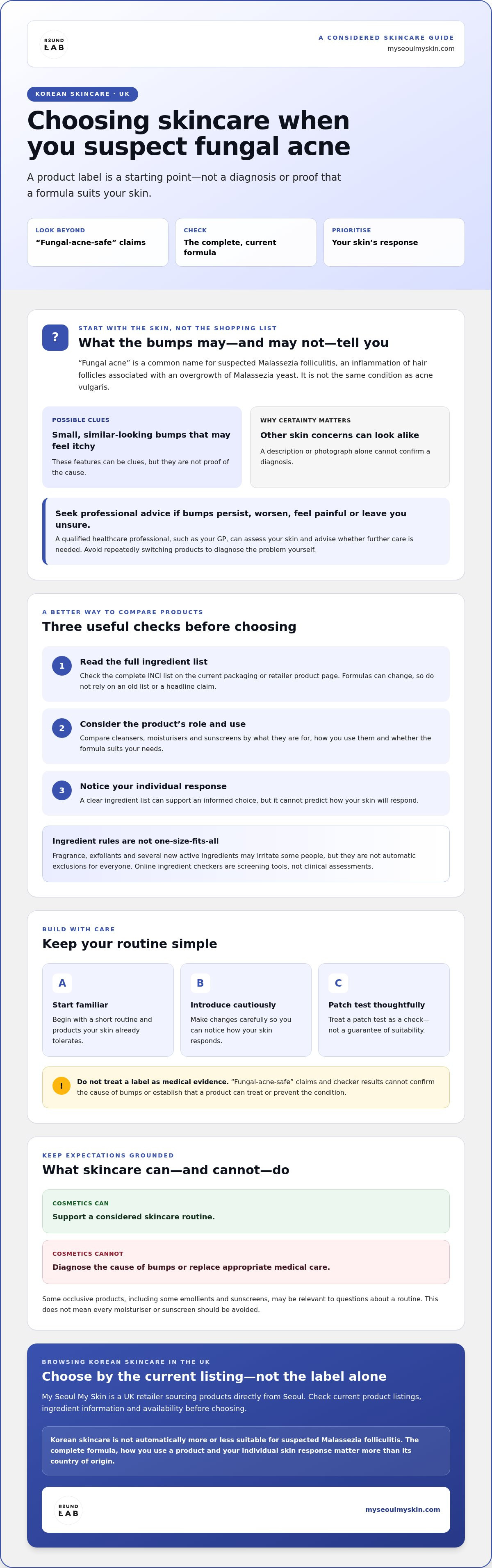
- See why the full formula, how you use a product and your skin’s response matter more than broad ingredient rules or Korean skincare labels.
- Compare cleansers, moisturisers and sunscreens by their role, ingredient-list transparency and how well they suit your skin when considering the best Korean products for fungal acne UK.
- Keep your routine simple, introduce changes cautiously and treat patch testing as a check, not a guarantee.
- Find out how to browse Korean skincare from My Seoul My Skin, a UK retailer sourcing products directly from Seoul, while checking current listings and ingredients.
Fungal acne in the UK: what the term means before choosing Korean products
Persistent bumps can be frustrating, especially when products aimed at ordinary acne don’t seem to help. Before changing your skincare, it helps to understand what “fungal acne” means and what the term cannot tell you. The practical first step is to avoid treating online labels as a diagnosis and make product choices with your skin’s comfort in mind.
“Fungal acne” is a common name for suspected Malassezia folliculitis, an inflammation of hair follicles associated with an overgrowth of Malassezia yeast. It isn’t the same condition as acne vulgaris, and bumps alone can’t confirm either diagnosis. Malassezia is naturally present on skin. For a basic overview of the condition, see Malassezia folliculitis.
What can make suspected fungal acne different from ordinary acne?
Suspected Malassezia folliculitis is often described as clusters of small, similar-looking bumps that may feel itchy. These features can be clues, but they aren’t proof. Acne vulgaris, folliculitis and other skin concerns can look alike, and their causes and appropriate care may differ. A description or photograph alone isn’t enough to diagnose what’s happening.
If the bumps persist, worsen, feel painful or leave you uncertain, speak to a qualified healthcare professional, such as your GP. They can assess your skin and advise whether further care is needed. Avoid repeatedly switching products to try to diagnose the problem yourself, as it can become harder to work out how your skin is responding.
Why product labels cannot confirm a diagnosis
“Fungal acne” on a product page or ingredient-checker result is a skincare marketing or categorisation term. It isn’t evidence that a product has medical effectiveness or is suitable for you. Online checkers can be a starting point, but they may simplify a complex formula. They can’t account for every ingredient combination, how a product is used or how an individual’s skin responds.
That’s why the search for the best Korean products for fungal acne UK shoppers can consider should start with realistic expectations, not a blanket “safe” claim. Check the complete, current ingredient list and introduce products thoughtfully. Remember, though, that a cosmetic routine can’t confirm the cause of bumps or replace appropriate medical care. Skincare may support your routine, while diagnosis and treatment decisions belong with a qualified professional.
How Korean skincare ingredients relate to suspected Malassezia folliculitis
Korean skincare isn’t automatically more or less suitable for skin prone to suspected Malassezia folliculitis. The complete formula, how often and where you use a product, and your individual response matter more than its country of origin. Even products in the same category can contain very different combinations of ingredients.
A product label alone cannot establish that a formula is suitable for suspected fungal acne, or that it can treat or prevent the condition. Cosmetic claims describe a product’s intended skincare role; they aren’t a diagnosis or proof of medical effectiveness. DermNet outlines risk factors for Malassezia folliculitis, including the possible role of occlusive products such as some emollients and sunscreens. This context can inform questions about your routine, but it doesn’t mean every moisturiser or sunscreen should be avoided.
Which product qualities should shoppers assess first?
Start with a short routine and products your skin already tolerates, rather than replacing everything at once. Read the complete INCI ingredient list on the current packaging or retailer product page, since formulas can change. Fragrance, exfoliants and several new active ingredients may irritate some people, but they aren’t automatic exclusions for everyone. Introduce changes cautiously so you can notice how your skin responds.
When comparing the best Korean products for fungal acne UK shoppers may find, focus on the actual product listing and current formula, not a headline claim. A clear ingredient list helps you make an informed choice, but it can’t predict your individual response.
Why “fungal-acne-safe” lists need careful interpretation
Third-party ingredient checkers are screening tools, not clinical assessments. A result may flag an ingredient using a simplified rule, without fully accounting for its derivative, concentration, role in the formula or combination with other ingredients. Two products that appear similar by category may therefore need different consideration. Treat checker results as prompts to review, not a definitive pass-or-fail verdict.
Keep the process manageable: check the full list, make one change at a time and pay attention to comfort. If you suspect an infection, symptoms persist, or you’re unsure what treatment is appropriate, ask a qualified healthcare professional rather than relying on product claims or online lists. To browse Korean skincare, you can explore Korean skincare at My Seoul My Skin. Check each listing’s current ingredients and availability before choosing.
How to compare Korean products for suspected fungal acne
Compare skincare by the job it needs to do in your routine, not by claims that it can treat folliculitis. A cleanser, moisturiser and sunscreen have different roles, and none can confirm or resolve the cause of persistent bumps. Use the comparison below to assess current product listings without assuming that a whole category, brand or ingredient is right for everyone.
| Product category | Purpose | What to check | Personal tolerance |
|---|---|---|---|
| Cleanser | Remove daily build-up as part of cleansing. | Read the full current ingredient list and directions. Look for instructions that fit your routine. | Choose an option that leaves your skin comfortable. Avoid harsh scrubbing or repeatedly washing to chase bumps. |
| Moisturiser | Provide a moisturising step that suits your skin and routine. | Review the complete formula, directions and any warnings. Don’t judge suitability from a front-label claim alone. | Consider whether you’ve used the formula before and how your skin responds. Comfort is individual. |
| Sunscreen | Provide sun protection as part of daytime skincare. | Check the full ingredient list, directions and warnings for the specific product. | Choose one you can use as directed and that feels comfortable on your skin. |
Choosing a cleanser, moisturiser and sunscreen
Keep each step focused on its everyday purpose. For cleansing, a comfortable feel matters more than a “deep clean” sensation. Choose a moisturiser that fits your routine and preferences, rather than selecting one solely because a website labels it suitable for fungal acne. Sunscreen remains a routine sun-protection step. Assess each product by its own ingredients and directions, not assumptions about all sunscreens.
The search for the best Korean products for fungal acne UK shoppers can consider is best approached one product at a time. Suitability can’t be established from a category name, and skincare isn’t a treatment for suspected folliculitis. For broader brand and shopping context, explore this Korean skincare UK reference guide.
How to assess a product before adding it
Before choosing, check the complete, current INCI list on the packaging or retailer listing, then read the directions and warnings. Consider whether the formula fits any sensitivities you already know about. Avoid introducing several unfamiliar products together. If your skin reacts, it will be harder to work out which change may be responsible. Check current listings and ingredients before purchase, as formulas and availability can change.
A cautious UK routine: introduce Korean skincare without overwhelming your skin
If your skin feels unsettled, resist the urge to overhaul your shelf. Pause unnecessary new products and keep to a minimal routine built around familiar steps you already tolerate. If you use prescribed skincare or medicines, don’t stop them without speaking to the clinician who recommended them.
Change one product at a time. This gives you a clearer picture of how your skin responds and makes it easier to identify a possible trigger. Keep a simple note of the product, when and where you used it, and any changes or discomfort. This is more useful than trying several products marketed among the best Korean products for fungal acne UK shoppers search for all at once.
How to introduce a new product carefully
First, read the current full ingredient list, directions and warnings. If you decide to try the product, follow its instructions and consider patch testing on a small area before using it more widely. Patch testing is a cautious check, not a guarantee that irritation won’t occur, and it can’t diagnose a skin condition. Introduce only one unfamiliar product at a time, then observe your skin as you use it according to the directions. If a concerning reaction develops, stop using it and seek professional advice if needed.
Keep the rest of your routine steady while you assess a change. Avoid adding new exfoliants or other unfamiliar products at the same time, as that can make a reaction harder to interpret. If a product feels uncomfortable, don’t push through simply because an online list calls it suitable.
When to ask a UK healthcare professional
Arrange advice from your GP if you’re unsure what’s causing the bumps, or if symptoms persist or worsen. Seek prompt professional advice for significant discomfort, spreading symptoms or other concerning changes. A clinician can assess whether the issue needs medical care and advise on appropriate next steps.
Don’t self-prescribe antifungal medicines based on a product checker or assume cosmetics can replace clinical treatment. For health advice, follow current NHS guidance or speak with a qualified healthcare professional. If you’re ready to browse, explore Korean skincare at My Seoul My Skin, then check each listing’s current ingredients and directions before making a choice.
Finding Korean skincare in the UK: a considered next step with My Seoul My Skin
Shopping for Korean skincare can be easier when product information is available through a UK retailer. My Seoul My Skin is a UK online retailer offering Korean skincare sourced directly from Seoul, including brands such as Numbuzin, VT Cosmetics, Abib and Jumiso. These are products to browse, not products confirmed to be suitable for suspected Malassezia folliculitis.
Keep the health decision separate from the shopping decision. A retailer or product label can’t diagnose a skin condition, and cosmetics shouldn’t be treated as a substitute for medical care. If you’re unsure what’s causing your symptoms, or they persist or worsen, speak with a qualified healthcare professional about assessment and treatment.
What to check when shopping for Korean skincare online
Before choosing a product, look for clear details and the complete ingredient list for its current formula. Check the directions and warnings, too, and consider whether the product fits your known sensitivities and existing routine. Don’t rely on a broad “fungal-acne-safe” label as a guarantee of suitability; individual responses can differ.
Product listings, formulas and stock can change. Confirm current availability and delivery terms directly on the retailer’s website before ordering, rather than relying on older advice or saved screenshots. If an ingredient list isn’t clear, don’t assume what the formula contains. Check with the retailer or choose a listing that gives you the information you need to make a considered decision.
Build a simple routine around your skin’s needs
Choose a small number of practical steps your skin tolerates, rather than adding a full routine at once. A cleanser, moisturiser and sunscreen each have different everyday roles; select them based on those needs, the product directions and your own experience. If you’re managing a diagnosed condition, follow your clinician’s advice about skincare alongside any recommended treatment.
For general inspiration on routine steps and the Korean skincare approach, read the Korean glass skin routine guide. It offers broader routine context, not guidance for diagnosing or treating fungal acne. The search for the best Korean products for fungal acne UK shoppers can consider is best grounded in careful product checks and appropriate professional advice, not a promise from a label.
Ready to browse? Explore My Seoul My Skin and review each product’s current listing and ingredients before deciding whether it belongs in your routine.
Choose your next skincare step with care
The search for the best Korean products for fungal acne UK shoppers can consider starts with caution, not a “fungal-acne-safe” label. Similar-looking bumps can have different causes, so a qualified healthcare professional should guide diagnosis and treatment, especially if symptoms persist, worsen or concern you.
For skincare, keep your routine simple, check each product’s complete, current ingredient list and introduce changes one at a time. A product’s formula and your personal tolerance matter more than its country of origin, and cosmetics aren’t a substitute for medical care.
My Seoul My Skin is a UK online retailer offering Korean skincare sourced directly from Seoul. If you’d like to browse, review current product listings and ingredients, and check delivery terms on the website before ordering. Explore authentic Korean skincare at My Seoul My Skin.
Take it one thoughtful step at a time. With clear information and the right professional advice when needed, you can make skincare choices with greater confidence.
Frequently Asked Questions
Is fungal acne the same as ordinary acne?
No. “Fungal acne” is a common term for Malassezia folliculitis, whereas ordinary acne usually refers to acne vulgaris. They’re different conditions and may need different care, but their bumps can look similar. Small, uniform or itchy spots may be associated with folliculitis, but appearance alone can’t confirm the cause. If you’re unsure, seek advice from a qualified healthcare professional rather than diagnosing your skin from online descriptions.
Can Korean skincare products treat fungal acne?
No cosmetic product should be relied on to diagnose or treat suspected fungal acne. Korean skincare can form part of a personal routine, but a product’s origin or marketing claims don’t establish medical effectiveness. If you suspect Malassezia folliculitis, ask a qualified healthcare professional about assessment and appropriate care. You can still choose skincare thoughtfully by checking the full current ingredient list and stopping use if a concerning reaction develops.
What ingredients should I avoid if I think I have fungal acne?
There isn’t a universally reliable avoid list that can diagnose the condition or predict everyone’s response. Online checkers may flag particular ingredients or ingredient groups, but they can simplify how a full formula works. Review the complete, current ingredient list, consider your known sensitivities and notice how your skin responds. If you suspect an infection or aren’t sure what to avoid, ask a clinician instead of making broad changes based on a checker.
How do I choose a Korean moisturiser for suspected fungal acne?
Choose by the full formula and your own tolerance, not a “fungal-acne-safe” label. Read the current ingredient list, directions and warnings, and consider whether the moisturiser fits your existing routine and known sensitivities. Introduce one unfamiliar product at a time so you can notice your skin’s response. The best Korean products for fungal acne UK shoppers can consider aren’t guaranteed to suit everyone, and a moisturiser won’t treat folliculitis.
Can I use Korean skincare if I have Malassezia folliculitis?
Possibly, but suitability depends on the individual product, your skin and any advice from your clinician. Check each formula’s complete, current ingredient list, follow its directions and introduce changes cautiously. Don’t assume all Korean skincare, or any whole product category, is suitable or unsuitable. If you’ve been diagnosed, ask your healthcare professional how to fit cosmetics around your recommended care, and don’t use skincare as a replacement for treatment.
When should I see a GP about bumps that might be fungal acne?
Contact your GP if you’re uncertain about the cause, or if the bumps persist or worsen. Seek prompt professional advice if you have significant discomfort, spreading symptoms or other concerning changes. Acne, folliculitis and other skin conditions can look alike, so a product list can’t confirm what’s happening. Avoid self-prescribing antifungal medicines or relying on cosmetics to treat the problem; a qualified professional can advise on appropriate next steps.